






Sunnyvale just signaled long-term confidence in its office market.
More importantly, it did so at a time when many nearby cities are still struggling with elevated vacancies and muted demand.
Ellis Partners has officially secured city approval to redevelop an office site near Moffett Park, adding nearly 300,000 square feet of modern office and research space to one of Silicon Valley’s most resilient submarkets.
And while this move might sound bold, the numbers suggest it may be perfectly timed.
A Strategic Redevelopment Near Google’s Sunnyvale Campus
At the center of the plan is the property at 333 to 385 Moffett Park Drive.
Rather than preserving aging infrastructure, Ellis Partners will remove two existing office buildings totaling 87,000 square feet.
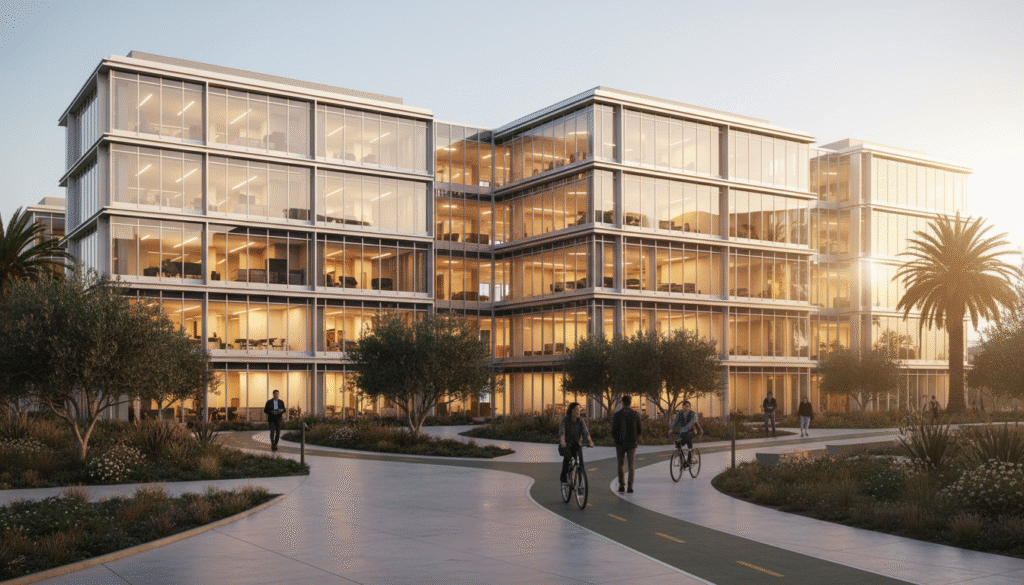
In their place, two six-story buildings will rise, delivering approximately 294,000 square feet of new office and R&D space.
Additionally, the project includes 800 parking stalls, a shuttle bus stop, and more than 43,000 square feet of private open space.
In other words, this is not a cosmetic refresh.
Instead, it is a full repositioning aimed at today’s workforce expectations.
Especially in tech-oriented markets, newer inventory with amenities continues to outperform.
According to CBRE, modern office properties consistently attract higher occupancy than legacy buildings, even amid broader market softness.
You can explore how large-scale developments are reshaping the region in this breakdown of new Bay Area mega projects:
https://temblog.org/the-new-bay-area-5-mega-projects-reshaping-the-real-estate-landscape-in-2025/
Sunnyvale’s Office Metrics Stand Out in Silicon Valley
What makes this approval notable is not just the scale.
Rather, it is the location.
Sunnyvale continues to outperform neighboring cities on office occupancy.
In the third quarter, Sunnyvale’s vacancy rate stood at 14.9 percent.
Meanwhile, the broader Silicon Valley market registered a higher 16.6 percent vacancy rate.
That gap may seem modest.
However, in commercial real estate, even a few percentage points can dramatically affect rents, leasing velocity, and long-term valuations.
CBRE data suggests that submarkets with vacancy below the regional average tend to stabilize faster and recover sooner during downturns.
This helps explain why developers are still willing to place strategic bets in Sunnyvale.
For a broader look at how supply and demand dynamics are shifting across the region, this weekly Bay Area housing and market update provides additional context:
https://temblog.org/bay-area-housing-market-update-this-week-prices-inventory-buyer-demand/
Ellis Partners Expands Its South Bay Footprint
Notably, this project is not an isolated move.
Earlier this year, Ellis Partners acquired Mathilda Tech Park, purchasing two buildings spanning 105,000 square feet across five acres.
The transaction was recorded at $15.5 million, according to Santa Clara County records.
Soon after, the firm also partnered with Baupost Group to acquire the Campus at Scott office park in Santa Clara.
That campus is largely occupied by Applied Materials, adding stable tenancy to the firm’s growing portfolio.
Step by step, Ellis is clearly concentrating capital where tenant demand remains relatively durable.
This mirrors a broader investor trend identified by outlets such as the Silicon Valley Business Journal and CBRE, which note increased interest in well-located, amenity-rich office hubs near major employers.
Construction Timeline and Market Outlook
The redevelopment process is expected to unfold methodically.
Ellis anticipates six to twelve months for permitting.
Construction, once underway, is projected to take roughly two years.
By the time the project delivers, the office market may look very different than it does today.
Historically, office supply cycles lag demand recovery.
Therefore, projects that break ground during periods of uncertainty often enter the market at more favorable moments.
For investors watching both residential and commercial trends, this echoes patterns seen across the Bay Area, including the divergence between luxury and mid-tier housing markets discussed here:
https://temblog.org/bay-area-luxury-homes-keep-rising-while-mid-tier-housing-slips-behind/
Why This Matters for the Bay Area
Ultimately, this approval underscores a broader narrative.
While parts of Silicon Valley remain challenged, not all submarkets are created equal.
Sunnyvale continues to benefit from proximity to major tech campuses, strong infrastructure, and comparatively healthier occupancy levels.
As a result, capital is still flowing where fundamentals justify it.
And for now, Sunnyvale remains firmly on that list.