



By Michael Torres – Chief Editor
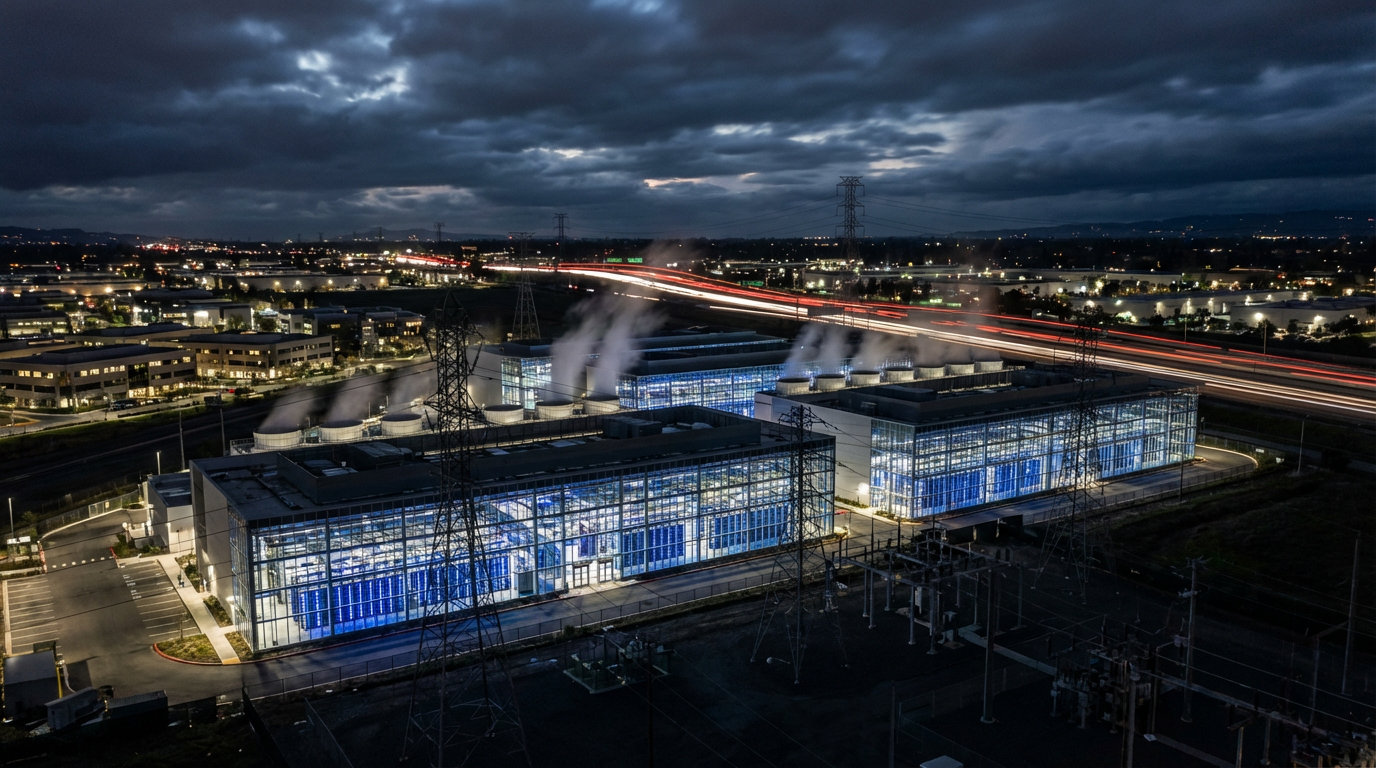
San Jose is rapidly becoming one of the most critical infrastructure hubs in the artificial intelligence economy, and a new project in North San Jose is further cementing that position. A nearly 100,000 square foot office and research property located at 300 Holger Way is officially in the process of being transformed into a full scale AI data center that will operate twenty four hours a day.
The building is being repositioned after Nvidia began leasing the space in late 2024. Exterior renovation work has already been underway for several months, signaling the early phases of a much larger infrastructure upgrade. Full construction related specifically to the data center development is scheduled to begin in December of 2026, with completion targeted for July of 2027.
Once operational, the facility will function nonstop, fully staffed at all hours, with controlled badge only access and continuous on site security monitoring. Cameras and security personnel will be present around the clock. This type of operational setup reflects the increasing role of data centers as critical infrastructure rather than traditional commercial real estate.
A Strategic Shift in the Bay Area Real Estate Market
This project is not just another lease or renovation. It represents a broader shift taking place across Silicon Valley and the greater Bay Area. As artificial intelligence continues to dominate the technology landscape, data centers have emerged as one of the most sought after real estate assets in the region.
Traditional office buildings that once struggled with vacancy are now being reevaluated as potential AI infrastructure hubs. Investors and developers are increasingly targeting properties in industrial and power rich corridors where energy capacity, fiber connectivity, and land availability align with the intense demands of AI operations.
North San Jose and Santa Clara have become focal points of this shift. Their proximity to major tech campuses, combined with grid infrastructure capable of supporting high energy usage, makes these areas highly attractive for large scale data operations.
The Office to AI Infrastructure Conversion Playbook
The transformation of 300 Holger Way follows a growing playbook now being used by commercial real estate investors across the Bay Area. Properties that were once optimized for office and research use are being repositioned into mission critical facilities that support artificial intelligence, cloud computing, and data processing.
For property owners, this strategy offers a powerful new exit opportunity. Office vacancy remains a challenge in many tech driven markets, but a successful conversion into a data center with a major tenant can drastically increase long term asset value while locking in stable income.
This trend is reshaping the investment landscape. Properties acquired years ago under standard office assumptions are now becoming high value digital infrastructure assets. The transformation changes not just how a building is used, but also how it is valued by investors and lenders.
Expanding Footprint Signals Aggressive Growth Strategy
The San Jose data center conversion is one piece of a broader physical expansion strategy underway. Nvidia has been actively increasing its real estate footprint across Northern California throughout 2025.
In Santa Clara, the company recently acquired a large office building exceeding one hundred thousand square feet in size. In San Francisco, it signed a major lease at Mission Rock, marking its first major footprint in the city. These moves signal a deliberate effort to expand both laboratory and operational infrastructure in multiple strategic locations.
Rather than concentrating exclusively on traditional suburban campuses, the company is now distributing operations across a wider geographic area that aligns with the evolving needs of AI development, data processing, and high performance computing.
Community and Infrastructure Considerations
While the expansion brings economic momentum and reinforces San Jose’s status as an AI infrastructure hub, it also introduces new challenges for surrounding communities and municipalities.
Data centers operate very differently from traditional office buildings. Their continuous operation places increased demand on power grids and water infrastructure. Noise from cooling systems, generator testing, and constant security activity can also create new environmental considerations.
City planners and local officials are expected to closely monitor compliance with all existing environmental and noise regulations as development progresses. As more of these facilities enter once office heavy districts, urban planning strategies may continue to evolve.
The Geography of Silicon Valley Is Being Redrawn
The development at 300 Holger Way reflects a deeper shift in the physical geography of Silicon Valley itself. The historic heart of tech centered around office campuses is increasingly giving way to distributed industrial scale operations built to support data and artificial intelligence.
Corridors in North San Jose, Santa Clara, and surrounding industrial zones are now emerging as the backbone of the next generation of computing infrastructure. This realignment is driven not just by corporate expansion, but by the technical realities of power, cooling, and fiber requirements that AI systems demand.
As the region adapts, the real estate market is being reshaped alongside the technology sector. Office square footage alone no longer defines importance. Infrastructure capability now determines value.
With construction set to begin in late 2026 and full operations expected by mid 2027, the transformation of 300 Holger Way stands as one of the clearest indicators yet that Silicon Valley’s next phase is being built not just on software, but on physical digital infrastructure.