



By Liana Cortez — Chief Editor, Bay Real Estate Review
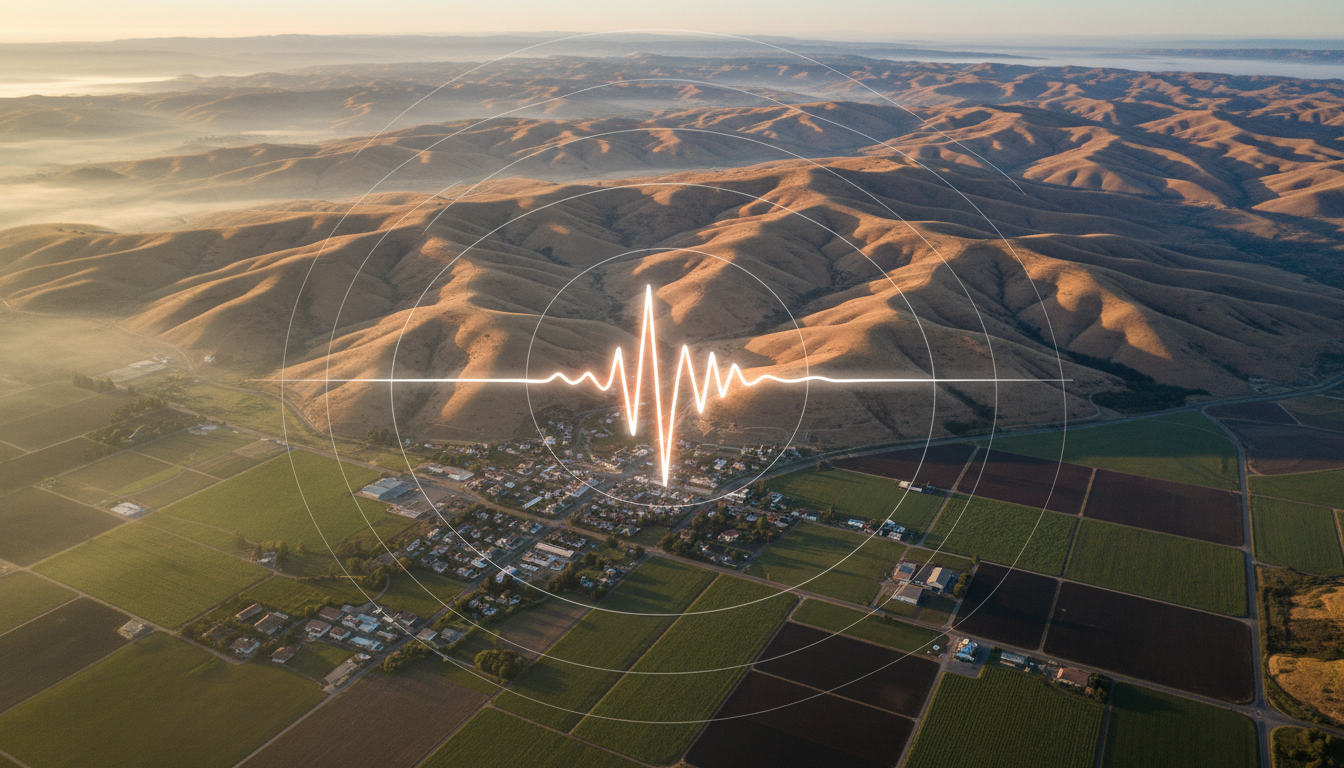
California’s Central Coast experienced a noticeable jolt on Thanksgiving Day as two earthquakes struck in rapid succession just south of San Juan Bautista, marking the latest in a growing pattern of seismic movement across the broader Bay Area region. The quakes, which hit less than ten minutes apart, were strong enough to be felt across multiple counties and have drawn increased attention from residents, emergency officials and seismic observers who note that the past week has been unusually active.
The first earthquake occurred at 12:48 in the afternoon with a magnitude reading of 3.9. Its epicenter was placed roughly three miles south of San Juan Bautista, an area known for its historic fault complexity and proximity to the central segment of the San Andreas. Although relatively brief, the initial tremor was widely noticed. People described windows vibrating, shelves trembling slightly and pets reacting quickly before the movement stopped. Only nine minutes later a second earthquake followed, this time measured at magnitude 4.0 and originating from the same vicinity.
Unlike the first, the second quake was felt over a much broader radius. Reports came in from Salinas, Monterey, Santa Cruz, Hollister and throughout the Central Coast, but also from areas well beyond its immediate perimeter. People as far north as San Francisco and Marin County reported a short rolling motion that lasted only a moment but was strong enough to be clearly identifiable. Southbound, the shaking reached into Monterey Bay communities where residents paused holiday gatherings to check for swaying furniture and hanging fixtures.
There were no immediate accounts of injuries or structural damage from either event, though local officials continue collecting reports as aftershocks remain possible. Minor items were knocked over in isolated instances, but no utility disruptions or transportation impacts have been documented.
A Week Defined by Movement Along the Fault
Thursday’s earthquakes did not occur in isolation. In the twenty-four hours prior, a magnitude 4.0 quake struck near Gilroy shortly after sunrise, followed by two noticeable aftershocks. Earlier that same morning three earthquakes were recorded near The Geysers, a prominent geothermal field in the North Bay known for regular seismic releases tied to deep underground energy activity. The strongest of those reached magnitude 3.9 and was felt in dozens of surrounding communities.
Further east, the San Ramon valley has recorded numerous smaller quakes over the last two weeks. While most were low in magnitude and largely unfelt, seismic clusters of this type indicate ongoing pressure redistribution along interconnected fault lines. None of these events signal a larger earthquake on the way, but together they highlight the constant movement that defines California’s landscape.
Experts have long noted that the state does not experience earthquakes in perfect isolation. Instead, motion in one region often coincides with subtle shifts in others. The current pattern is not cause for alarm, but it offers a timely reminder: quiet periods should never be mistaken for geological stillness.
Preparedness Remains the First Line of Defense
With holiday gatherings underway and families spread across homes, restaurants and coastal communities, the Thanksgiving shaking served as an abrupt refresher course on readiness. Emergency officials are encouraging residents to take simple precautionary steps while conditions remain calm. These include reviewing household emergency kits, storing water and batteries, securing tall furniture to wall-mounted supports and identifying safe drop-cover-hold locations within the home.
Even moderate earthquakes can disrupt roads, power infrastructure and communication channels, particularly in older neighborhoods with aging utilities. A well-prepared household can continue operating when services temporarily falter, and officials consistently emphasize that preparedness dramatically reduces risk during larger events.
For long-time residents, Thursday’s activity was a familiar experience, but for newcomers relocating from less active regions, it may have been a first introduction to the natural behavior of the West Coast. Seismic activity is not an anomaly here. It is simply part of life, woven into the geography and history of the region.