





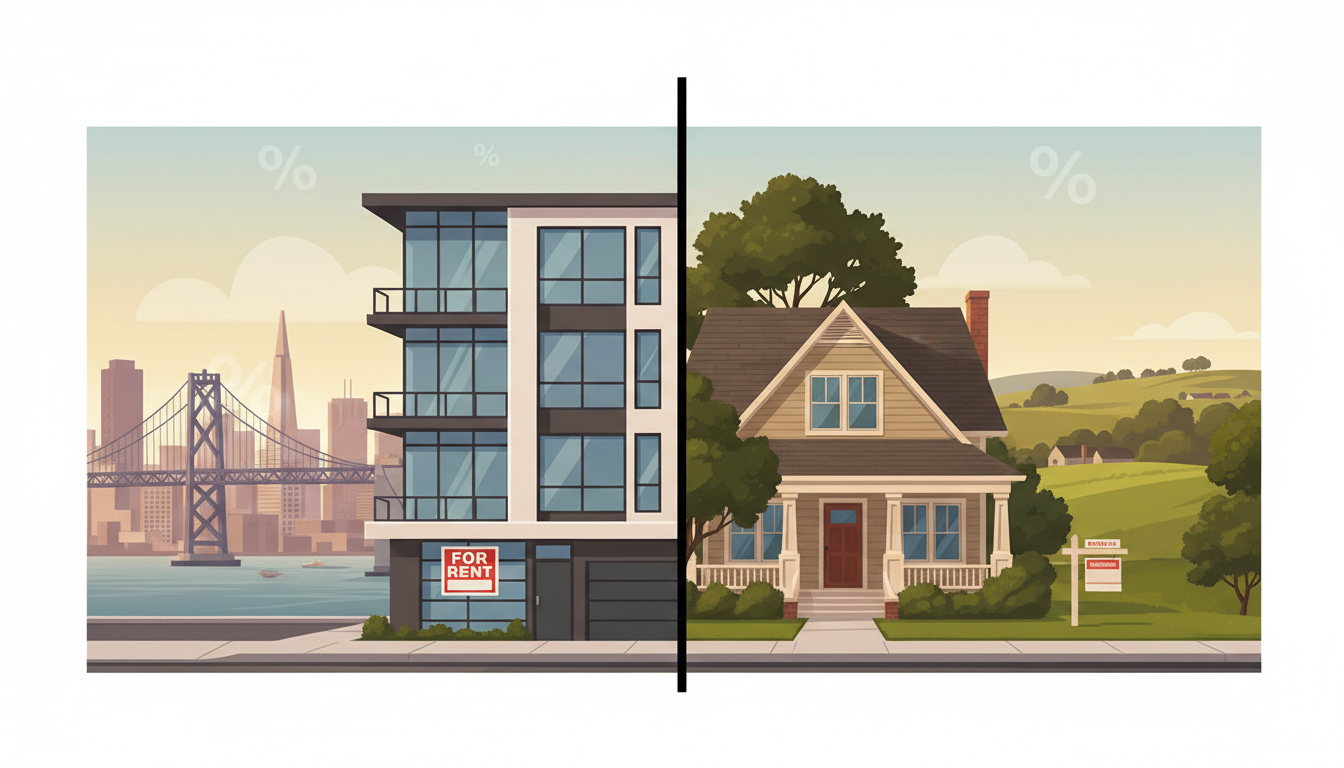
At first glance, deciding whether to rent or buy in the Bay Area feels simple.
In reality, however, the decision has become one of the most complex housing questions in the country.
On one side, home prices remain among the highest in the nation.
On the other side, rents are climbing again after a short pause.
Meanwhile, interest rates continue hovering well above pandemic-era lows.
Because of this, many households feel caught in the middle.
For that reason, a structured rent vs buy analysis is no longer optional. It is now essential.
A quick reality check on today’s Bay Area market
Across California, housing costs already exceed national averages.
In contrast, the Bay Area stretches even further beyond those norms.
For example, statewide rents hover in the upper-$2,000 range.
In many Bay Area cities, however, monthly rents regularly exceed $3,000.
At the same time, median home prices across core Bay Area metros still push past $1 million.
As a result, the Bay Area rent vs buy question is not about choosing between cheap and expensive.
Instead, it is about choosing between two different kinds of expensive.
For ongoing shifts in prices, supply, and buyer behavior across the region, this weekly update provides helpful context:
https://temblog.org/bay-area-housing-market-update-this-week-prices-inventory-buyer-demand/
How the rent vs buy math actually works
Many people compare rent directly to a mortgage payment.
That shortcut, however, often leads to the wrong conclusion.
A proper rent vs buy analysis focuses on non-recoverable ownership costs, which usually include:
- Mortgage interest
- Property taxes
- Home insurance
- Maintenance and repairs
- HOA fees, when applicable
Because of this, analysts often rely on the “5% rule.”
Put simply, this rule estimates that about 5% of a home’s value per year goes to non-equity costs.
For example:
- A $1,000,000 home
- Multiplied by 5%
- Equals $50,000 per year
- Or roughly $4,166 per month
If you can rent a similar property for well under that amount, renting usually wins in the short term.
For personal estimates, these external calculators help refine the numbers:
- https://www.calculator.net/rent-vs-buy-calculator.html
- https://www.nerdwallet.com/mortgages/rent-vs-buy-calculator
- https://www.fidelity.com/calculators-tools/rent-vs-buy
When renting usually makes more sense in the Bay Area
In many cases, renting works best when flexibility matters most.
Renting often makes sense if:
- You may move within 5–7 years
- Your job location could change
- Cash flow matters more than long-term equity
- You want to avoid maintenance surprises
Shorter time horizons raise ownership risk.
Closing costs, selling fees, and market swings all become more dangerous over short periods.
Because of that, when your future plans are unclear, renting is often the safer option.
When buying still wins in the Bay Area
Despite the price tags, buying can still make sense in the right situation.
Ownership often works best when:
- You plan to stay long term
- Your income is stable
- You can handle upkeep without stress
- You value consistency over flexibility
Over time, the Bay Area continues to benefit from:
- Strong income growth
- Ongoing demand
- Tight land supply
Because of that, owners often gain protection from rising rents while building equity at the same time.
Location changes everything
It is important to remember that the Bay Area is not a single market.
Each sub-region behaves differently.
For example:
- San Francisco and the Peninsula often favor renting due to steep entry prices
- Oakland and parts of the East Bay sit closer to the break-even point
- Outer South Bay and further East Bay lean toward buying for space and value
Future development also plays a major role.
New construction corridors often reshape where demand flows next.
You can see how upcoming mega-projects are already shifting ownership trends here:
https://temblog.org/the-new-bay-area-5-mega-projects-reshaping-the-real-estate-landscape-in-2025/
How interest rates reshape the rent vs buy decision
Mortgage rates directly control monthly payments.
When rates rise:
- Payments increase
- Buying power shrinks
- Qualification becomes harder
At the same time, rising rates often cause:
- Rental demand to increase
- Inventory to tighten
- Builder incentives to grow
Because of this, buying never fully disappears. Instead, buyers simply adjust strategy.
How to use a Bay Area rent vs buy calculator correctly
To get usable results, follow this order:
First, gather real local price data.
Next, enter your down payment, taxes, insurance, and HOA costs.
Then, add maintenance and a realistic interest rate.
After that, compare results over 3, 5, 7, and 10 years.
Finally, adjust for how long you actually plan to stay.
This process turns the calculator into a planning tool instead of a guessing game.
Hybrid strategies many Bay Area residents now use
Because neither renting nor buying is perfect, many people mix both over time.
Common strategies include:
- Renting near work while buying further out
- Buying small first, then upgrading later
- Buying with an ADU to offset payments
- Renting first while preparing financially for ownership
This approach rewards flexibility without giving up long-term opportunity.
What the Bay Area rent vs buy decision truly comes down to
At the end of the process, most decisions fall into four simple questions:
How long will you realistically stay?
How heavy is your current rent burden?
How resilient is your income and savings?
How much do you value flexibility versus control?
When flexibility leads, renting usually wins.
When stability leads, buying often becomes the better move.
Final verdict
The Bay Area rent vs buy analysis is no longer a quick calculation.
Today, it has become:
- A timing decision
- A lifestyle choice
- A financial risk decision
- A long-term planning strategy
More than anything, it is now a personal strategy—not a universal rule.