




Written by: Marcus R. Delacroix, Chief Editor
Introduction: A Sudden Surge in the Caribbean
On November 13, 2025, the United States initiated its most significant military buildup in the Caribbean since the 1989 invasion of Panama. The deployment, officially described as a counternarcotics operation, places overwhelming American firepower directly off the coast of Venezuela—a nation struggling with a weakened military, an oversized leadership structure, and years of economic collapse.
While Washington speaks in terms of drug interdiction, the scale and sophistication of the forces involved suggest a far more consequential strategic message: the U.S. is demonstrating what overwhelming regional dominance looks like in 2025, and Venezuela’s conventional forces—once touted as a regional power—are now a hollow version of what they were a decade ago.
The U.S. Buildup: A Show of Unmatched Force
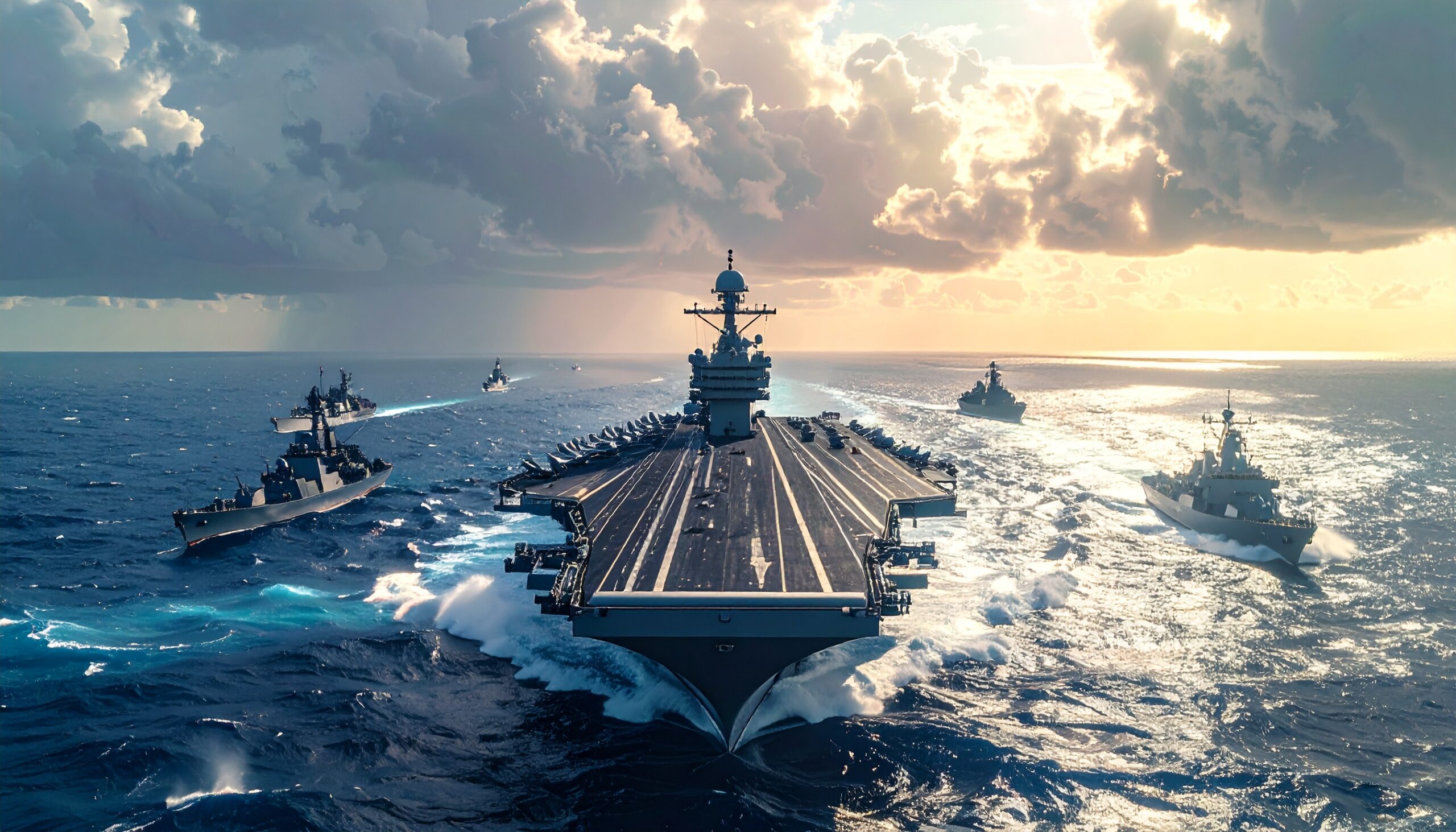
At the center of the American deployment is the USS Gerald R. Ford, the U.S. Navy’s most advanced and lethal aircraft carrier. The ship represents a floating city of air power, sensors, and long-range strike capability—an unmistakable symbol of American intent.
Accompanying the Ford is a formidable strike group:
- Over a dozen warships
- Including a cruiser
- Multiple destroyers
- An air and missile defense command ship
- Amphibious assault vessels
- An attack submarine lurking below the surface
- Air power expansion:
- 10 F-35 fighter jets stationed in Puerto Rico, adding stealth and reconnaissance dominance to the theater
- Personnel:
- Approximately 15,000 U.S. military personnel deployed across sea and land assets
This concentration of force dramatically shifts the operational environment. In any conflict scenario—conventional or hybrid—the U.S. would control the air, sea, and information domains within hours.
Venezuela’s Armed Forces: A Military in Decline
Personnel by the Numbers
Venezuela’s regular military, the FANB, stands at roughly 123,000 active personnel, distributed as follows:
- Army: 63,000
- Navy: 25,500
- Air Force: 11,500
- National Guard: 23,000
- Reservists: ~8,000
On paper, this appears substantial. In practice, however, the force is undermined by structural, economic, and material decay.
A Top-Heavy Command
The FANB’s command structure is notoriously inflated.
In 2019, U.S. Southern Command estimated that Venezuela had around 2,000 generals and admirals—more than all of NATO combined.
For comparison:
- United States (2025): ~850 generals/admirals for a force ten times larger.
This extreme top-heaviness reflects political loyalty, not military efficiency. It has created a stratified force where bureaucracy overwhelms operations, promotions are political, and genuine modernization is nearly impossible.
Equipment Reality Check: Strength on Paper, Weakness in Practice
Throughout the 2000s and early 2010s, Venezuela acquired large quantities of Russian equipment to project itself as a regional military power. Yet over 10 years of economic crisis and underinvestment have eroded readiness across the board.
The International Institute for Strategic Studies (IISS) describes the result bluntly:
A “rather low level of operational capability and asset availability.”
Army
- Tanks:
- 92 Russian T-72B1
- 81 French AMX-30
- Infantry Fighting Vehicles:
- 123 Russian BMP-3
- Artillery:
- Russian Msta-S howitzers
- Smerch rocket launchers
The hardware is formidable in theory, but maintenance, spare parts, and crew training have suffered under sanctions and economic collapse.
Air Force (Bolivarian Military Aviation)
- Fighter Jets:
- Flotte of Russian Su-30MK2s (nominally 24; at least 3 lost to crashes)
- A handful of old F-16s
The Su-30s could challenge U.S. aircraft in isolated engagements—but “isolated” is the keyword. Flight readiness rates are low, pilot training hours are minimal, and U.S. air dominance would be overwhelming.
Air Defense
A notable area of strength—though heavily compromised by age and maintenance issues.
- Long-Range: 12 S-300 batteries
- Medium-Range: 9 Buk systems
- Short-Range: 44 Pechora units
- Portable: Numerous Igla-S launchers
Defense analysts note that in any real conflict, these systems would be the first targets, and given the sophistication of U.S. electronic warfare and precision strikes, their survival time would be measured in minutes or hours, not days.
Navy
Here the weakness is most pronounced.
- Only one Mariscal Sucre-class frigate (Italian)
- Only one Type-209 submarine (German)
- Nine patrol vessels, some Spanish-built
- Critically, no viable anti-air defenses on most ships
Against a U.S. carrier strike group, Venezuela’s navy would be rendered ineffective almost immediately.
The Bolivarian Militia: A Political Creature, Not a Fighting Force
Created by Hugo Chávez and expanded by Nicolás Maduro, the Bolivarian Militia is extremely large on paper but almost entirely ineffective militarily.
Conflicting Size Claims
- IISS estimate (2024): 220,000
- Maduro’s claims:
- August 2025: 4.5 million
- Later: 8 million
These numbers are widely considered political theater.
Defense analyst Andrei Serbin Pont describes the militia bluntly:
“Those people do not have sufficient training… would not be effective in combat.”
Their real function is internal:
- Domestic surveillance
- Civilian intimidation
- Political control
Militarily, they are not a credible factor against a modern conventional force.
Expert Assessments: Capability vs. Reality
Serbin Pont and other regional analysts emphasize that the FANB’s issues are not merely logistical—they are systemic.
Operational Capability
“The FANB has a rather low level of operational capability and asset availability.”
—Serbin Pont
Militia Function
Primarily useful as an “intelligence network and a repressive threat,” not a battlefield force.
Air Defense Vulnerability
Advanced systems “would likely be the first targets” in any conflict.
Strategic Balance: Overmatch on Every Front
The U.S. buildup is not a preparation for imminent conflict—it is a demonstration of decisive overmatch.
Air Dominance:
F-35s, carrier aircraft, drones, and U.S. radar coverage would wipe out Venezuelan air operations quickly.
Naval Dominance:
Venezuela’s navy would not survive modern maritime warfare.
Ground Forces:
While Venezuela’s army is sizable, it lacks mobility, logistics, and air cover—fatal weaknesses against a technologically superior opponent.
Militia:
Not a factor in conventional conflict.
Conclusion: A Regional Reality Check
The U.S. deployment in the Caribbean underscores a stark imbalance of power. For Venezuela, years of economic collapse, political purges, and underinvestment have left the military large on paper but fragile in practice. For the United States, the operation signals more than counternarcotics—it’s a reminder of regional dominance and a warning to any state seeking to challenge it.
This moment is not just a military comparison—it is a geopolitical message written in steel, jet engines, and carrier decks.