




Chief Editor: Marcus Hale
Across the Bay Area, road conditions vary dramatically block to block and city to city. Some communities are driving on newly resurfaced asphalt, while others dodge potholes deep enough to swallow a tire. A new regional pavement review shows exactly how wide the gap has become — and which cities are leading the way in road maintenance.
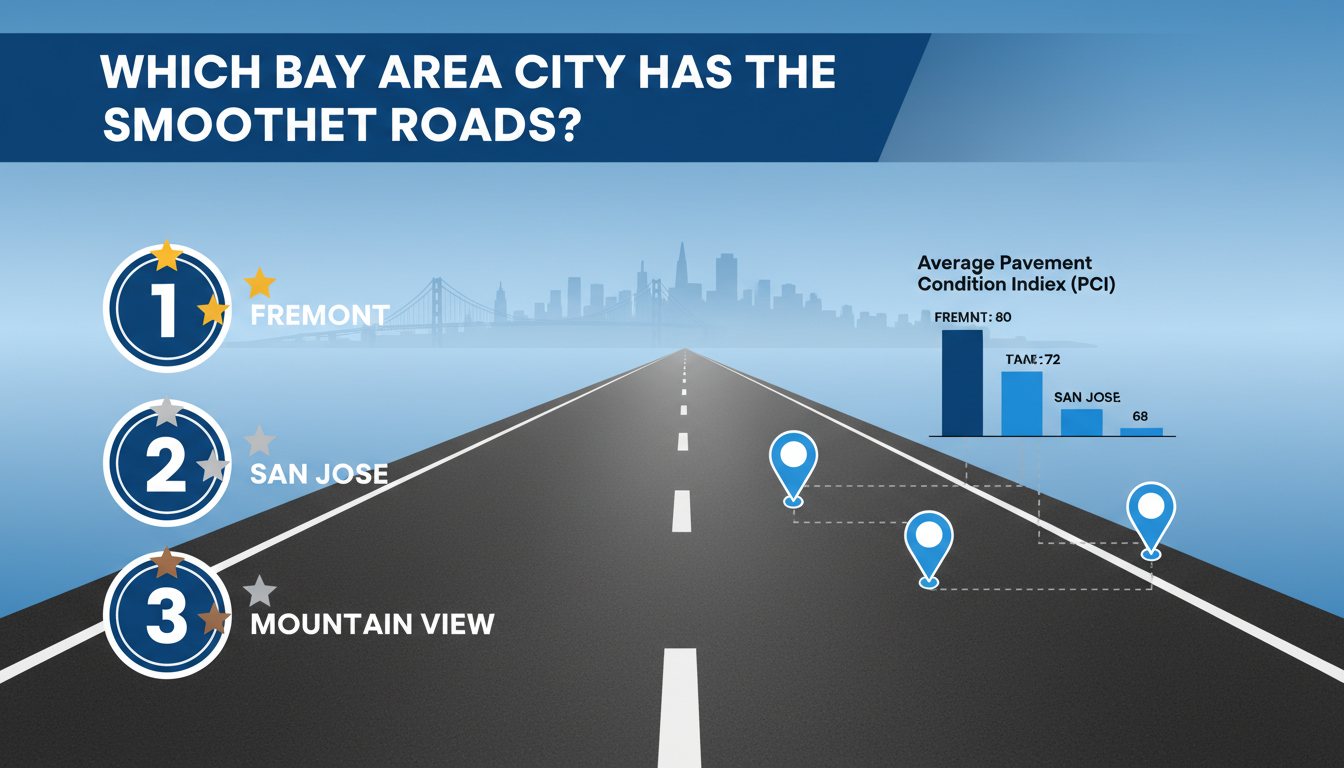
The results reveal one clear number one: a suburban community on the northern edge of the region now holds the highest pavement score recorded this year, officially ranking as the smoothest and best-maintained roadway network in the Bay Area.
🥇 The City With the Best Roads in the Bay Area
The top-ranked city did not get here by chance. Years ago, its streets were listed among the worst in the region. Residents complained, drivers dodged cracks, and the city faced long-term infrastructure decay.
All of that changed after a series of major road rehabilitation campaigns, resurfacing the entire street network from edge to edge. Today, every mile of roadway has been rebuilt, sealed, and upgraded — a transformation that took roughly five years but elevated the city from near-bottom to the very top.
Smooth pavement, minimal cracking, and fresh asphalt intersections make it the most comfortable place to drive in the entire Bay Area.
🚗 Other High-Ranked Cities
Four additional cities reached the top bracket with excellent pavement scores, each classified as “very good.” What they have in common is consistent investment, predictable maintenance schedules, and long-term transportation planning rather than crisis-reaction repairs.
Communities in this tier include:
- A South Bay tech-hub city with widespread resurfacing projects
- A peninsula community known for well-funded infrastructure
- An East Bay hillside town with carefully planned maintenance cycles
- A quiet residential region with one of the smallest road networks — but the highest upkeep quality
These cities represent the benchmark for what well-maintained Bay Area streets look like when investment is prioritized.
🚧 The Lowest-Ranked Roads: Where Driving Is the Roughest
At the very bottom of the rankings sits the city currently holding the weakest pavement score. Years of deferred maintenance left many streets cracked, uneven, or visibly deteriorating. But there is progress — voters approved new funding streams specifically for road repair, which are expected to pump tens of millions into resurfacing every year going forward.
The turnaround may take time, but the financial structure is finally in place.
🏙 What About the Bay Area’s Major Cities?
The 3 largest population centers fall in the middle of the rankings — not failing, not outstanding, but stable:
- The region’s densest metropolitan city scored in the Good range
- The South Bay’s largest city landed slightly below but still within Good quality
- The East Bay’s biggest city sits in At-Risk condition, maintained but aging faster than it’s being restored
One of these cities is filling potholes at a record pace, completing more repairs in 18 months than it did in the previous decade. Another has quietly repaved 10% of its entire street grid every year for nearly eight straight years — a massive undertaking that most cities cannot match.
💰 Funding Will Decide the Future
A massive regional funding measure scheduled for public vote next year could change the trajectory of road quality for the next 30 years. The proposal would generate billions annually, with a portion earmarked exclusively for road maintenance, repaving, and surface rehabilitation.
Some counties would receive hundreds of millions in infrastructure support, while one major coastal city plans to direct nearly all its transportation funding toward public transit instead of road expansion.
The shape of our roadways — smooth or crumbling — may depend on that single vote.
FINAL TAKEAWAY
The Bay Area’s road system is a story of contrast. One city now holds the smoothest streets in the region. Others are climbing upward with strong investment. A few are still fighting their way out of decades of decline.
Drivers already know what the rankings confirm:
where you live determines how smooth your commute really feels.